


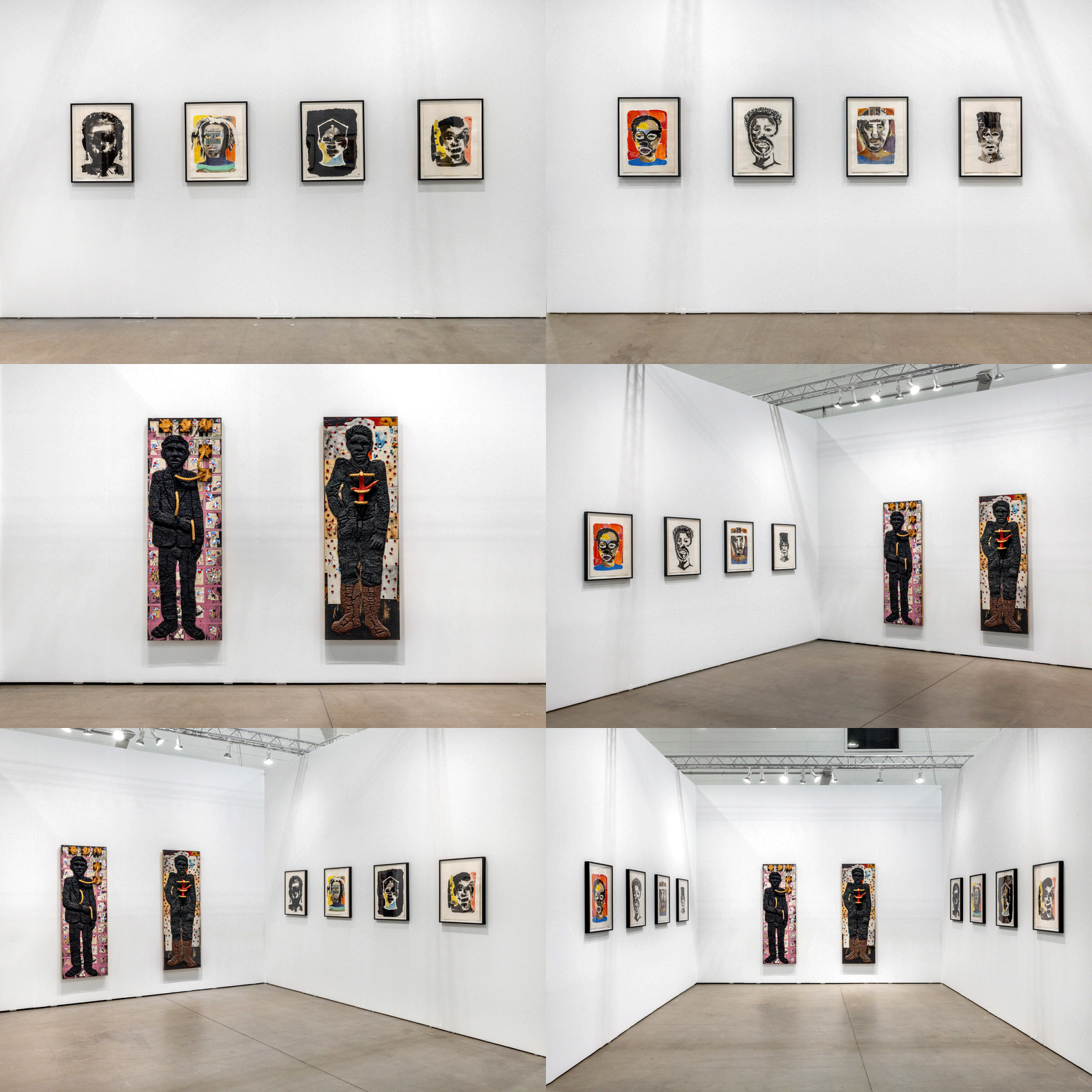
During the last twenty minutes of EXPO CHICAGO this year, I came upon the Magenta Plains booth from New York—deep in that final stretch where attention gives out and everything feels like a blur. The fair, at that hour, is a cacophony of commerce and tired heels; I was aimlessly meandering through the noise, and probably should have been heading toward the exit.
Out of the corner of my eye, I spotted a line of works on paper that made me hit the brakes.
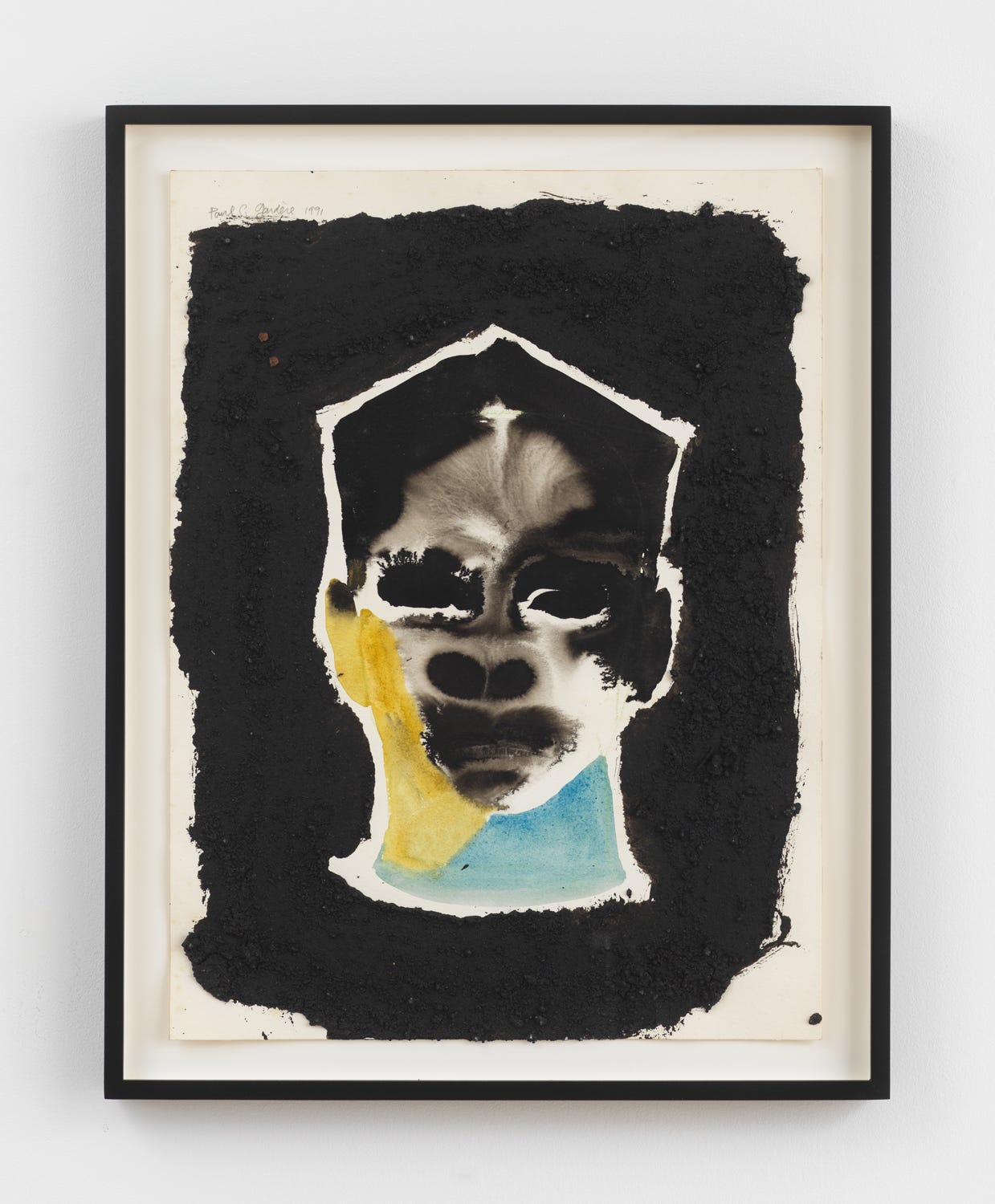
Faces—stained, unformed, ruptured, still developing—see-sawed between breakdown and emergence. They didn’t settle into resolution; they held together and came apart at the same time. In one work, Untitled (Heads No. 36) (1991), the face appears less drawn than unearthed. A dense field of mud surrounds it—granular, uneven, pressing in from all sides—while the head itself is held within a stark, irregular white contour, as if it has been cut out or revealed from the surface rather than placed onto it. The features don’t fully resolve. The top of the head angles upward into a pitched form, and just above the forehead, at the edge of the hairline, an open, cross-shaped area interrupts the surface—an absence that sits at the threshold of the face rather than fully within it. The eyes sink into shadow, the nose and mouth hover between presence and dissolution. Color enters sparingly—a wash of yellow along one side of the face, a cool blue at the base—but it doesn’t describe so much as it seeps through the form. The surface feels active, unstable, as if the image is still in the process of becoming.
I noticed the signature on the works: Paul C. Gardère. French, European—traveled to my brain. Then I noticed the date written on one of the works: 1991.
That detail interrupted how I was looking. This was clearly the work of a mature artist, not an emerging one, yet the works didn’t date themselves in a way that felt anchored to their specific time period. They felt much fresher than their thirty-five to thirty-seven years. They didn’t just survive the decades; they seem to have bypassed them entirely to remain present.
The disruption sent me looking for the history behind the hand. Gardère, a Haitian-born artist (1944–2011), produced these works—collectively titled The Heads (1989–1991)—across two pivotal New York residencies: the Studio Museum in Harlem (1989–90) and the Jamaica Arts Center (1991–92). The Magenta Plains presentation brought these rarely exhibited pieces together with two works from his later Mud & Rope series.
While The Heads were originally conceived as studies for that later series, that framing doesn’t fully hold once you stand with them. It made sense for the two series to be presented together; seeing them in the same space revealed a shared lineage. The materials—a miscellany of watercolor, mud, ink, gouache, postcard collage, and shoelaces—do not behave like “preparatory” sketches; they hold themselves as complete works.
What held me there was not “image” in the conventional sense, but the way Gardère navigates the surface. He allows the watercolor to spread and settle unevenly in places, yet anchors the work with areas of sharp definition that give the features their weight. The faces feel as if they are still forming as you look at them—never fully arriving, never fully closing. Even the works rendered in black ink carry that same sense of suspension. They don’t offer graphic certainty; instead, they keep recognition from settling—exerting a kind of pressure on attention that keeps it active rather than allowing it to rest.
In relation to the Mud & Rope works, the material logic of these drawings expands into three-dimensional assemblage. Gardère incorporated soil and rope into layered surfaces, building figures that hold the instability of the earlier drawings in denser form. Mud, in these works, is not illustrative; it behaves. It dries unevenly, fractures, and shifts as it settles, introducing an unpredictability that resists control. The granular “mud” suggested in the 1991 drawings becomes physical here, where the earth itself becomes the medium of the face.
The rope functions similarly—it binds but does not provide closure. It holds things together while making the pressure of that holding visible. It is structure without finality. Seen in this way, The Heads do not sit “behind” the later works as preliminary steps. They sit inside the same logic, operating under the same conditions, just in a different register of material intensity.
That this specific work—Untitled (Heads No. 36)—was selected as a 2026 Northern Trust Purchase Prize recipient felt like a rare moment of institutional alignment with the experience of the work. When I finally left the booth, the rest of the fair returned at its usual speed. But something of that encounter remained—less as an idea than as a shift in how I was looking. My attention felt less like something I directed, and more like something that could be held—pressed into, even—by the surface in front of me, as if the work itself continued to emerge there, just beyond where it seemed to settle.
b♥©